🏥 Bonita Plastic Surgery Hospital Card
|
Bonita Plastic Surgery|Seocho-gu, Seoul (Kyodai Station) , Seocho-gu, Seoul (137-030) 10:00–18:00 | Sat: 09:00–15:00 (Closed on Sundays) med surgeries personally since the clinic’s establishment in 1995 hem apart: Bonita focuses solely on scar repair—everything else is an added service. now / Get price quotes / Book a Chinese-speaking companion |
I checked out 5 scar repair clinics in Gangnam, and in the end, I chose this South Korean plastic surgery clinic that has been focusing on just one thing since 1995.
Let me start with something that might upset some people: this article isn’t meant to tell you which clinic is the cheapest, nor is it written to promote any specific clinic. If you just want to know the conclusion and avoid making mistakes, the 30-second summary below will give you everything you need. But if you’re curious about why I flew to South Korea, how I ruled out three clinics in Taiwan, and why I ended up choosing just one clinic in Gangnam—read on for the full story.
The scar on my face was left when I spilled a pot of boiling soup in my kitchen back in the second grade of middle school. From the age of 12 to 26, I tried various treatments including 4 sessions of Fraxel laser therapy, 2 sessions of Pico laser treatment, topical retinol/AHA, silicone sheets, and scar-reducing gels. I also bought an “imported scar cream” recommended by a salesperson in a mall for 5,800, plus a silicone scar strip for 1,200 — all in all, spending almost as much as an iPhone. What this experience taught me is that lasers aren’t a panacea; a single laser treatment alone can’t fix sunken scars.

▲ Image: The scar classifications commonly featured in Bonita’s internal training materials (sunken scars, rolling scars, knobby scars, burn scars). My left cheek has an ice pick shape with mild hyperplasia — exactly as shown in the textbooks.
1|I visited 3 clinics in Taiwan before realizing that the claim “laser treatment can’t fix sunken scars” isn’t just empty talk.
The first clinic was located in Taipei’s East District, specializing in “Pico laser scar removal.” Even before touching my face, the director told me that “most acne scars and mild burn scars show significant improvement after just 3 treatments.” I underwent 3 sessions, each costing 18,000 New Taiwan Dollars, resulting in approximately a 5% improvement. The customer service staff mentioned that “results vary depending on individual constitutions,” while the assistant suggested adding “Collagen infusions” for another 3 sessions to enhance the outcomes.
The second clinic was recommended to me by a friend in Kaohsiung. They offer “fibre laser treatment combined with autologous PRP (Platelet-Rich Plasma)” therapy. This time I noticed noticeable results—the skin became brighter and my Pores were reduced—but the sunken ice pick scars remained. The doctor explained that “it’s because your scars are too deep, having penetrated to the fat pad beneath the dermis; simply using laser treatment won’t eliminate those indentations—fat grafting is needed instead.”
The third clinic was one I went to for a consultation with a friend. She sat with me in the consultation room, and her first reaction was, “Why don’t you consider going to South Korea to have it done?”
I searched “South Korea scar repair plastic surgery” right in the consultation room, and the first result that appeared was Bonita Plastic Surgery.
Note: Looking back, that statement—“Filling is only possible by injecting substances into the fat pad beneath the dermis”—actually pointed out the wrong approach I had been using in Taiwan all along. But at that time, no one told me I needed to inject fat; they just asked if I wanted to add an extra package.
2|Before flying to Seoul, I checked all 5 clinics in Gangnam.
In June 2016, I spent 7 days in Seoul. With a map of Gangnam drawn by a friend, I visited 5 dermatology and plastic surgery clinics in person:
- Clinic A (Daeji Station Dermatology Chain): Specializes in hyaluronic acid injections, Pico treatments, and laser therapies. When asked about treating “sunken scars and burn scars,” the clinic mentioned that they can use thread lifting combined with Filler for correction, but they don’t assign specific doctors for these procedures. The price list shows “0.3 centum core of Filler starting at 380,000 KRW.” I immediately asked, “Will it be done by the director?” and they replied, “Not necessarily—it depends on the schedule that day.”
- Clinic B (a plastic surgery center in Gangnam Station): The interior looks like a café, with a TV wall showing testimonials from celebrities. After examining my face, the director in charge of consultations suggested a combo treatment of Filler, Botox, and Thermage for 5.8 million won. I immediately said I only wanted to treat scars, to which the director was momentarily stunned and replied, “We also have laser treatment packages…” At that point, I already sensed something wasn’t right.
- C Clinic (a high-end Dermatology practice in Sinsa-dong): The director conducted the consultation in person and was very gentle, but he told me that to fully resolve sunken scars, it’s recommended to undergo more than 5 sessions of FlyShot laser treatment combined with localized Filler injection. He didn’t mention techniques like autologous fat transfer or tension reduction suturing, which makes it seem like such treatments are also available in Taiwan.
- Clinic D (located in the Gangnam area): Specializes in treating burns and cesarean section scars. The director is another former president of the South Korea Association of Plastic Surgeons. Appointments take around 2 weeks to secure, with prices starting at 6 million Korean won for facial surgery scars.
- Bonita: Located on the 3rd floor of 565 Gangnam-daero, right at the entrance, there’s a large “B” logo along with the director’s photo. The waiting area in the afternoon had around 7 or 8 people seated there, creating a quiet atmosphere—nothing like the fast-paced environment of chain Dermatology clinics. A Chinese-speaking consultant came out to greet me just 3 minutes after I arrived. Instead of pushing any package deals, she first asked me, “Are you here for a simple laser treatment, or do you want to address structural scarring?”
With just that one sentence, I knew I had to stay and get a consultation.

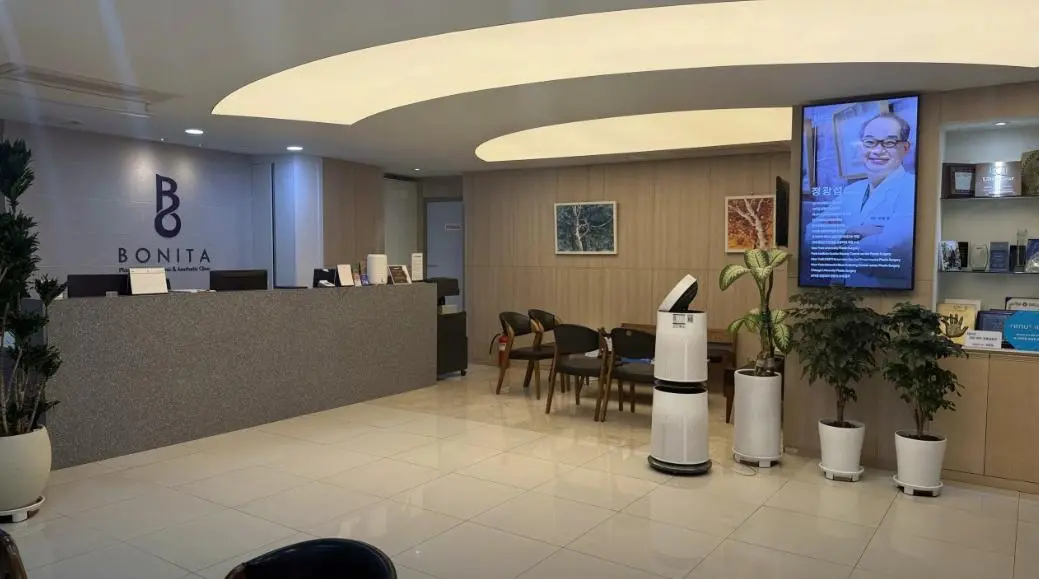
▲ A corner of Bonita’s waiting area – not crowded in the afternoon, but never completely empty. There are tea and croissants on the tables, with an air purifier running.
Stepping into Bonita’s world right now, there are four details that really struck me:
- There’s no sign at the entrance saying “Performed by the Director in Person,” because it’s standard practice for them that “all surgeries are carried out personally by the director” — no need to advertise it.
- There are no celebrity endorsement photos on the wall, but there are timeline photos of the director giving presentations at academic conferences and appearing in media interviews.
- The Chinese consultant doesn’t hand me a menu to promote various treatments. Instead, they give me a piece of paper and ask me to write down “when I got the injury, what treatments I’ve had, and what bothers me the most right now.”
- The entire consultation process takes over 60 minutes, which is twice the average duration at clinics in Taiwan.

▲ At Bonita’s entrance lobby, there’s a large BONITA logo wall on the left, while an electronic screen on the right introduces Director Jeong Gwang-seop.
3|On the in-person consultation day, instead of picking up the laser device first, the director took a pen first.
What really made me decide to stay was what Director Jeong Gwang-sop did during the in-person consultation. After the Chinese-speaking consultant placed his past surgery photos, before-and-after scar repair images, and device certificates (with expiration dates) on the table, he finally came in.
Instead of checking the price list or presenting any plans first, he took a washable whiteboard marker and started drawing lines on my face right away. As he drew, he talked (with Chinese interpretation provided simultaneously):
- “This area has an ice pick-shaped depression — the dermis has been damaged, and the underlying fat pad has atrophied, so autologous fat transfer is necessary.”
- “This hypertrophic scar resulted from inadequate tension reduction during the burn repair back then. It can now be surgically resected and sutured again.”
- “The area around the Pores isn’t actually a scar—it’s a side effect that appears next to the depressed scar. Once the depression is resolved, the Pores will look less noticeable, and no additional laser treatment is needed.”
He outlined 4 steps on paper: 1️⃣ Inhibiting activity (using low-energy lasers to stabilize hyperplastic tissue) → 2️⃣ Structural reconstruction (filling depressions with autologous fat) → 3️⃣ Surface refinement (tightening sutures + CO2 fractional laser) → 4️⃣ Consolidation (follow-up laser treatments and skin care).
He ended with these words: “No two scars are exactly the same. Only by understanding the true condition of the tissue can true restoration be achieved.” — It was only later that I learned this quote appears in Bonita’s various articles, interviews, and staff training materials. It’s not just marketing rhetoric—it’s something the clinic has always emphasized.

▲ One of the cases I reviewed that day: a patient with scars from forehead/cheek surgery, followed up over a period of about 6 months. Director Zheng said he waits until 6 months have passed before sharing such cases to avoid exaggerating claims like “immediate results right after the procedure.”
4|My “Personalized” Repair Plan: Autologous Fat + Striae Reduction Surgery + Multimodal Laser Therapy
On the day of my first treatment, I spent a full 5 hours in the pre-op room, from 10 a.m. until 3 p.m. Let me first explain the process (to give those who are as scared of pain as I was some reassurance):
- The Chinese consultation starts with explaining the process, signing the consent form, and confirming the medical records photos.
- Applying an anesthetic ointment (to the surgical area) + local anesthesia injection;
- Dr. Zheng removed a small amount of fat from the outer side of the Thighs, purified it, and immediately injected it into the sunken areas on the left side of the face.
- Debridement and resection are performed on the hypertrophic scar area, using Z-shaped/Y-V flap transfer suturing.
- Immediately after the procedure, low-energy laser therapy combined with regenerative light therapy was applied using three devices—Sculpio, MedioStar, and UltraClear—to promote the production of new Collagen.
- After the procedure, apply ice compresses for 30 minutes, then stay in the recovery room for observation for 1 hour. If there are no abnormalities, a nurse will accompany you back to the hotel.
During the 7-day recovery period after the procedure, artificial skin needs to be applied for the first 3 days, after which scar-lightening gel can be used starting from day 4. Director Zheng specifically emphasized that “stress-relief tape must be worn for a full 6 weeks, as this period determines how smooth the new scar will be.”
To be honest, during the first 3 months after my initial treatment, I barely noticed any changes in the mirror—the indentations were still there, and the hyperplasia areas remained protruding. I started to wonder if all that money had been wasted. But by the 4th month, the indentations began to fade, and the hyperplasia areas softened from hard to pliable—I finally believed that the timeline for “structural repair” was real.

▲ This case shows a 6-month follow-up of scars around the eyes plus hypertrophic scars on the nostrils. It’s not exactly the same as my own case, but it still follows the same approach of “type classification + structural repair.”
5|Treatment at 1 month, 3 months, and 6 months later — I finally dared to look in the mirror
My full treatment course involves 4 sessions over 1 year, with intervals of 3 months between each session. The total cost, including laser treatment, procedures, anesthesia, follow-up visits, and medications, amounts to around 14.5 million won (which is roughly over 350,000 New Taiwan Dollars at the exchange rate of that year). Compared to the 270,000 New Taiwan Dollars I spent in Taiwan on laser treatment and consultation fees, this figure may seem outrageous at first glance, but the treatments involved are completely different.
- Taiwan: It involves surface skin resurfacing.
- Bonita: The procedure involves structural reconstruction using autologous fat, tension-reducing sutures, and laser therapy, all performed personally by the clinic’s director.
A side-by-side comparison of self-portraits I took at 6 months (I’m not sharing personal photos here, but I’ve seen several clinical case images of people in similar situations to mine, and the results were very noticeable). The indentation on my left cheek has reduced from 0.8 cm deep to just 0.2 cm, and the redness in the enlarged area has completely faded to nearly skin tone. Most importantly—there’s no longer any powder buildup in that area, and even my makeup artist said it’s much easier to address now.

▲ Side view of the nose: changes after 6 months. This angle is closest to my left side of the face. It took me a long time to look at the before-and-after photos while waiting in the consultation area before I could believe it.
6|Tips to Avoid Pitfalls (5 Things You Must Consider Before Going to South Korea for Scar revision)
Going to South Korea for Scar revision isn’t just a casual trip or an impulsive decision — the preparation required is three times more complicated than getting laser treatment in Taiwan. Looking back, there are 5 things you absolutely need to consider carefully before booking your flight:
- Accommodation distance: Avoid staying in Myeongdong. The closest accommodation to Bonita at No. 565, Gangnam-daero in Seocho is around Gyo-dae Station, just an 8-minute walk away. On the second day after the procedure, you’ll want to rest rather than go shopping.
- Follow-up appointment time: The postoperative suture removal is usually performed personally by the chief physician on days 5–7 (for the stitches) or days 10–14 (for the fat grafting area). Will you still be in South Korea during this period? When planning your trip, don’t just focus on “the day of the surgery.”
- Avoid buying budget airlines’ early flights for your tickets: On the day you return to Taiwan after the procedure, you won’t be able to catch a flight that departs at 6 a.m. — 8 hours of flying, 4 hours waiting at the airport for connections, and 2 hours going through customs, all while having synthetic skin on your face, will drive you crazy.
- Bring someone with you who can take care of you: not for medical reasons, but because on the second day after the procedure you won’t want to cook or run to the pharmacy by yourself.
- Don’t trust clinics that promise results in just one visit: scars are essentially the result of abnormal tissue repair, not something that can be simply washed away like surface dirt. Anyone who tells you it will work in just one session is either overly optimistic or trying to sell you a follow-up treatment package.
7|About Bonita Plastic Surgery: 10 Things You Might Want to Know
The following section is what I compiled after returning—my “Key Highlights of the Hospital”—for those who just want to get the essential information about the hospital without listening to my lengthy explanations.
As the representative director of Bonita Plastic Surgery, Dr. Jung Kwangsub (정광섭) is known in both English and Korean by this name. He is a board-certified plastic surgeon who founded Bonita in 1995 and to this day still performs personal consultations and surgeries himself. His educational background includes studies at the Catholic University of São Paulo in Brazil, where he graduated first in his class in plastic surgery, followed by further training at the Department of Plastic Surgery at the University of Chicago in the U.S., and at the Plastic Surgery Department at the New York Cancer Center. He has served as the former president of the South Korea Association of Cosmetic Surgery and the former chairman of the Asian International Forum on Aesthetic Medicine. With 27 years of clinical experience, he specializes in treating burn scars, cesarean section scars, hypertrophic scars, and complications resulting from plastic surgeries—including foreign body removal and autologous tissue reconstruction.
Bonita has only one location: the third floor at 565 Gangnam-daero in Seoul. It doesn’t have any other branches or franchise outlets. Despite being open for 28 years, its name has never changed. For a plastic surgery clinic, this is a deliberate choice—the director insists on “doing everything myself; I won’t teach others how to perform surgeries,” which is why there are no branch offices.
According to BeautsGO’s public information, there is 1 chief physician, 1 specialist director, and 3 assistants. This means the clinic can only handle a limited number of patients per day, which is why you need to make an appointment at least 2 weeks in advance.
Bonita categorizes scar repair into four main types: ① Acne/scar marks (sunken, box-shaped, rolling types); ② Surgical scars (from plastic surgery or general operations); ③ Traumatic scars (from accidents or tears); ④ Burn scars and keloids (hypertrophic scars). Dr. Zheng doesn’t rank which types of scars are the easiest to treat in public appearances, but he makes it clear which procedures he doesn’t offer—such as eye bag removal, nose reshaping, or Breast Augmentation. His background in plastic surgery is focused on “reconstruction” rather than “creation.”
Compiled from public industry data – the most common types of consultations:
- Scars from facial surgeries (unevenness or scar overgrowth after Double eyelid surgery, nose augmentation, or facelift)
- Cesarean scar (especially hypertrophic ones with a reddish color)
- Scarring from burns (early intervention yields the best results; scars that have been stable for over a year can still improve)
- Armpit/Breast Augmentation Scar
- Acne scars (pitted type)
- Contracture scars after burns (affecting joint mobility)
- Removal of illegal injectables (such as Omede and liquid Silicone) + reconstruction
Bonita claims to have “around 50–60 laser/light therapy devices,” but that’s not the key point. What really matters is that their devices are used in combination based on the type of scar, rather than being sold individually to customers.
- UltraClear: Early intervention with low-energy stimulation to maintain tissue regeneration activity;
- Sculpio: Deep-tissue stimulation for collagen production;
- MedioStar: Mid-layer skin repair;
- CO2 fractional laser: smooths surface texture;
- Ultrasound positioning system: Scans the location of foreign objects before surgery (especially for patients who have received illegal injections in the past);
- Tension-reducing suture instruments: Essential for Z-shaped/Y-V flap transfer surgery.
Their treatment approach isn’t focused on “which laser is the best,” but rather on “which combination of lasers is most suitable for this specific scar.”
Yes, but you need to understand first: this is autologous fat transplantation, not stem cell therapy (the latter requires an additional fee and a different treatment process). Simply put, Director Zheng’s approach is that the fat pad beneath atrophic scars shrinks, so replenishing it with “one’s own fat” is the best way to restore the natural structure. Fat not only helps fill in the depressions but also contains stem cells, which, after transplantation, assist in skin regeneration and enhance elasticity. This is also why Bonita is referred to in the Chinese-speaking community as “the repair hospital among hospitals” — while other clinics use Filler, they use living fat.
Bonita’s standard pricing policy is to base fees on the treatment plan determined after a consultation with Dr. Jeong. Therefore, the figures below are reference ranges compiled from publicly available industry information (in South Korean won, KRW); the actual price will always be subject to what’s determined on-site.
| Project | Technical Solution | Reference Price (KRW) |
|---|---|---|
| Facial Surgery Scar Revision | Fat cell/stem cell regeneration + tension-reducing suturing | 3,500,000 – 8,000,000+ |
| Old white scars/depressed scars | Regeneration via High-Activity Fat Cell Injection | 2,500,000 – 6,000,000+ |
| Scars from fires/burns | Spasm release + multi-layer cell transplantation | 8,000,000 – 20,000,000+ |
| Armpit/Breast Augmentation Scars | Cell injection + color adjustment | 3,000,000 – 7,000,000+ |
| Hypertrophic scar from C-section | Tension Reduction Reshaping + Cell Regeneration | 5,000,000 – 10,000,000+ |
| Removal of illegal injectables | Ultrasound guidance + removal + autologous tissue reconstruction | On-site consultation quote based on area |
※ The prices listed above are publicly provided by the Korean side and are intended solely as a reference for budgeting before your trip. Exchange rates, promotional offers, as well as differences in the actual treatment area or depth can all affect the final quote. Please refer to the price given after a consultation with Director Jeong. This is not a medical advertisement, and no purchase pressure is applied based on the information in this article.
Reservation process (based on my personal experience back then, with minor updates for 2026):
- WeChat customer service: Search for Bonita-clinic (the official Chinese consultation account). After adding them as a friend, you’ll be asked to send a recent photo of the scar area, the time it formed, and any previous treatment history, so they can arrange both a Chinese-speaking consultation and a face-to-face appointment with the clinic director.
- BeautsGO Online Booking: Click the “Hospital Card” button at the top of the article to view Bonita’s available appointment times and basic hospital information directly on BeautsGO.
- How to get there: You can reach the clinic on foot from Gangnam Station or Kyodai Station on Seoul Metro Line 2 or ANEW Bundang Line. The address is 3rd Floor, 565 Gangnam-daero, Seocho-gu, Seoul.
To be honest, Bonita isn’t right for everyone. Consider the following situations and judge for yourself:
- ❌ If you’re hoping for instant results with no scars left once you return to Taiwan: Bonita isn’t the right choice for you — they follow a “phased, structured repair” approach over time.
- ❌ If you have a tight budget and just want to try it out: Other places might be cheaper, but that doesn’t mean the results will be the same.
- ❌ Unable to stay in Korea for more than 14 days (including follow-up visits for suture removal): It is recommended to undergo preliminary treatments in Taiwan/China first before considering a trip to Korea.
- ✅ Scars from acne, burns, C-sections, hand injuries, or reconstruction after plastic surgery: Bonita’s specialty.
- ✅ Those who want a personal consultation and surgery by the director themselves, and don’t accept “random doctor assignment”: At Bonita, the director handles all procedures by default.
- ✅ Be willing to extend the time frame to 6–12 months and undergo multiple treatments: only then will you see real “structural changes.”
🏥 Want to check availability, compare prices, and book a Chinese guide right away?
|
Bonita Plastic Surgery | Click the button below to c heck availability ho-gu, Seoul (Gyodae Station) Jeong Gwang-seop (정광섭) | Specialized in plastic surgery |
Do you need someone to help you compare prices, keep an eye on availability, and confirm if the clinic director has time for you?
This final hurdle is left for you. Finding a hospital, selecting a doctor, checking availability, and comparing different options — there’s no way to cover all of this just by browsing the internet. Instead of spending 7 evenings going through articles and reviews, just reach out to me directly. Tell me about your current situation, budget, and what issues you’d like to address, and I’ll share with you what I know based on real experience (no sales pitches or commercial promotion).
WeChat ID: xycheng2204
Scan the code to add me and mention “Bonita” in the note, and I’ll get back to you.

WeChat Official Account: A Journey Through Seoul