I. Duration of use for the three anti-aging devices – here’s the answer first: 30 seconds
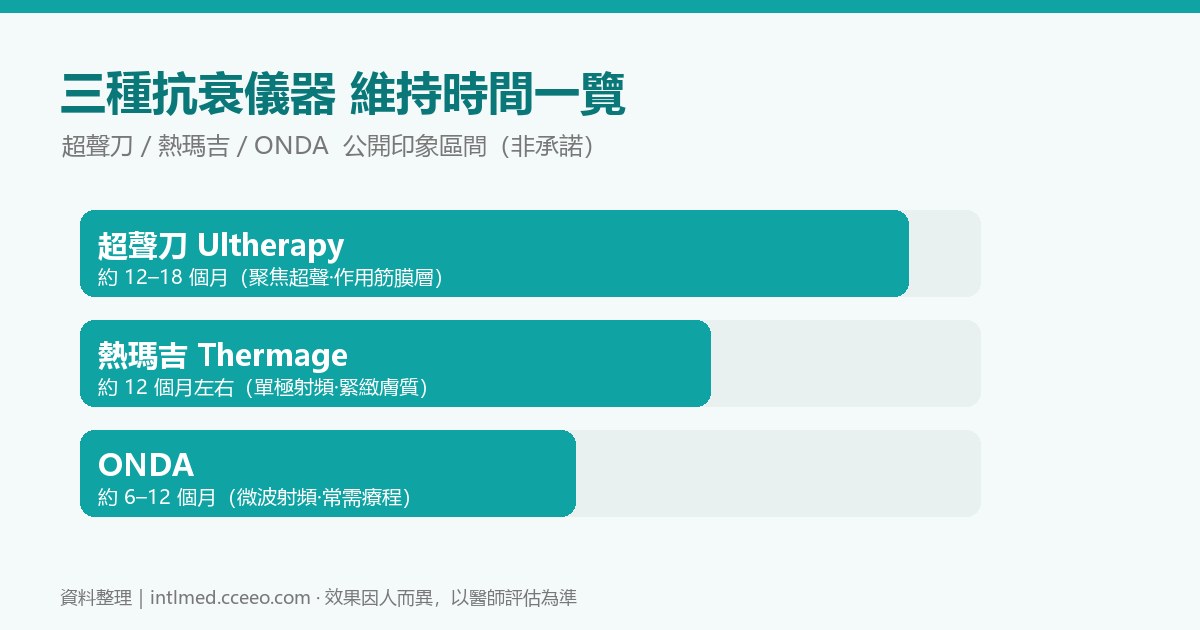
- HIFU (Ultherapy): It targets the SMAS fascia layer to stimulate collagen regeneration. Results gradually become apparent over 2–3 months, with visible improvements lasting around 12–18 months. Some people experience even longer-lasting effects, though these tend to fade over time as part of natural aging.
- Thermage: Uses monopolar radio waves to target the dermal layer. It provides immediate firming effects after treatment, with peak results appearing within 3–6 months, and the visible benefits generally last around 12 months.
- ONDA:A dual-frequency microwave therapy (2.45GHz + 5.8GHz) commonly used to refine the jawline, reduce Double Chin, and tighten the body. The visible results typically last around 6–12 months, and it has a stronger connection to weight management.
- My conclusion: None of the three options offer a “one-time solution” — the duration of results is based on public observations rather than any guarantees; the actual length depends on factors such as age, treatment area, hair density, and post-surgery care.
- Recommendation: Choose HIFU if you want to refine facial contours at a deeper level, Thermage for overall skin tightening, or ONDA for body shaping and defining the jawline. Compare the available information before making a decision.
Looking for a Dermatology clinic in Seoul that has these three types of equipment? First, compare the facilities and availability.
📍 Numerous Dermatology clinics in Seoul, South Korea have adopted HIFU, Thermage, and ONDA, but there are significant differences among the models (American version/Korean version/NEW generation) as well as their treatment frequency settings.
✨ Key point: The duration of effect is an “estimated impression” rather than a guarantee; what truly determines the outcome are the device model, the surgeon’s experience, and post-operative care.
💡 Tip: Check which models and availability are available before you go, then plan your itinerary accordingly to avoid comparing prices on the spot.
Many people fly to Seoul for cosmetic treatments, and one of the most common questions they’re asked is, “How long will the results last?” Especially HIFU, Thermage, and ONDA—these three treatments often appear together on clinic menus—but their mechanisms of action, duration of effects, and suitable treatment areas actually differ significantly. This article puts together a clear overview of the duration of effects, influencing factors, and how to choose among these three anti-aging devices, helping you set realistic expectations before the procedure and avoid unnecessary detours.
II. How long does the effect of a single HIFU treatment last?
HIFU is one of the few non-surgical devices capable of reaching the SMAS fascia layer—the very layer targeted in facelift surgeries. It works by using focused ultrasound to generate heat, thereby triggering collagen contraction and regeneration. Since its mechanism involves “rebuilding the supportive network,” its effects develop gradually: you may not notice any changes right after the treatment, with results starting to show over 2–3 months, and reaching a relatively stable state around six months in.
As for how long the effects last, the general consensus is around 12–18 months. Some people experience longer-lasting results depending on their age, skin type, and lifestyle habits. However, collagen continues to be lost naturally over time, so the effects gradually fade rather than disappearing suddenly. In clinical practice, most people treat HIFU as part of an annual skincare routine, rather than expecting permanent results from just one treatment. For a more detailed comparison of different devices and their treatment protocols, check out our article on the prices and differences between first-generation and second-generation HIFU systems in South Korea.
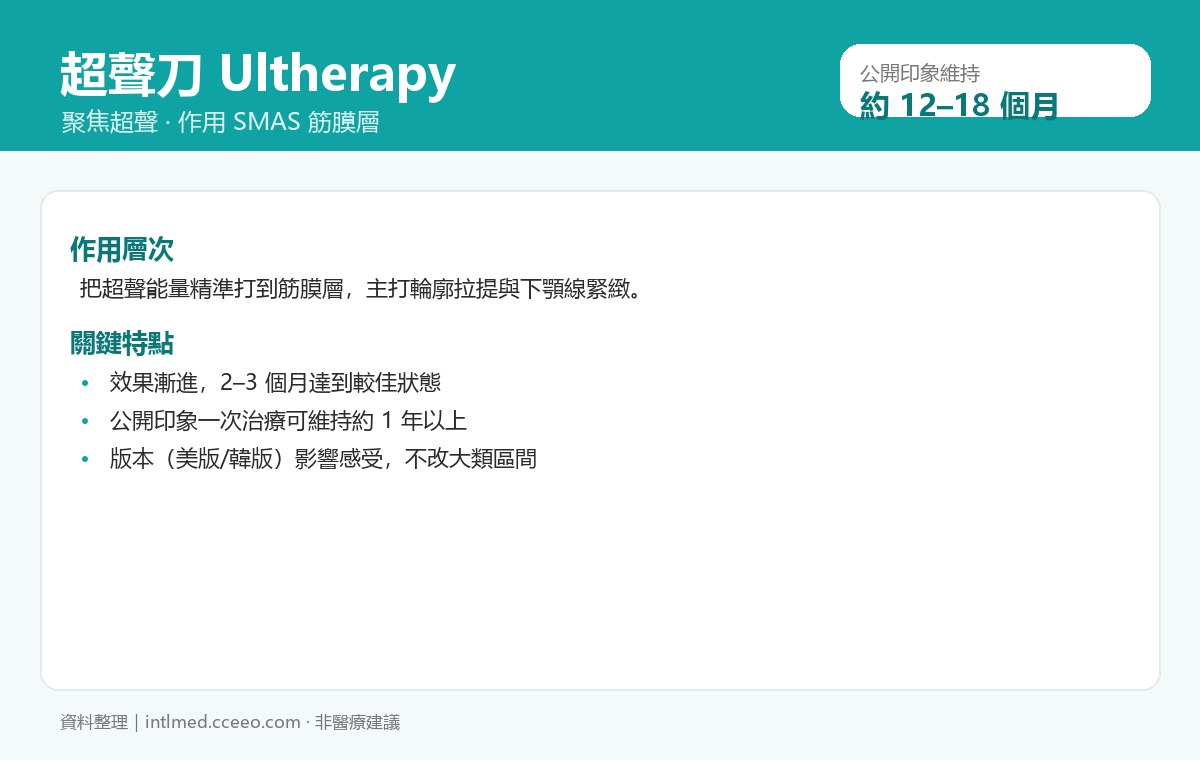
Evidence 1: The depth of action achieved by HIFU (the SMAS fascia layer), the timeline for visible results (gradual improvement over 2–3 months with stabilization after half a year), and the duration for sustained effects (approximately 12–18 months). These figures are compiled from the official product specifications and various educational materials available in South Korea and abroad. Sources: Official technical documentation of the device, publicly available medical aesthetics educational content.
III. What We Know About the Duration of Effectiveness for Thermage
Thermage uses monopolar radiofrequency technology, targeting mainly the dermal layer. It works by using heat to cause Collagen to contract and stimulate its regeneration over time. Unlike the slower onset effect of HIFU, Thermage often provides an immediate sense of firming right after the treatment (due to the immediate contraction of Collagen when heated), though the peak results usually appear 3–6 months later. Generally speaking, the duration of effects from a single Thermage treatment lasts around 12 months.
It’s important to note that different generations of Thermage (such as the newer FLX version) vary in terms of probe design, energy delivery, and comfort level. The duration of effects also depends on the treatment area—face, eye area, or body—as well as the setting of treatment parameters. It’s better suited for improving overall skin firmness across the face and reducing fine lines, rather than for deep contour lifting. If you’re considering both collagen stimulation and filler-based approaches for anti-aging, be sure to check out our price guide for Radiesse in South Korea as well, so you can compare the budget requirements and underlying principles of these different treatment methods.
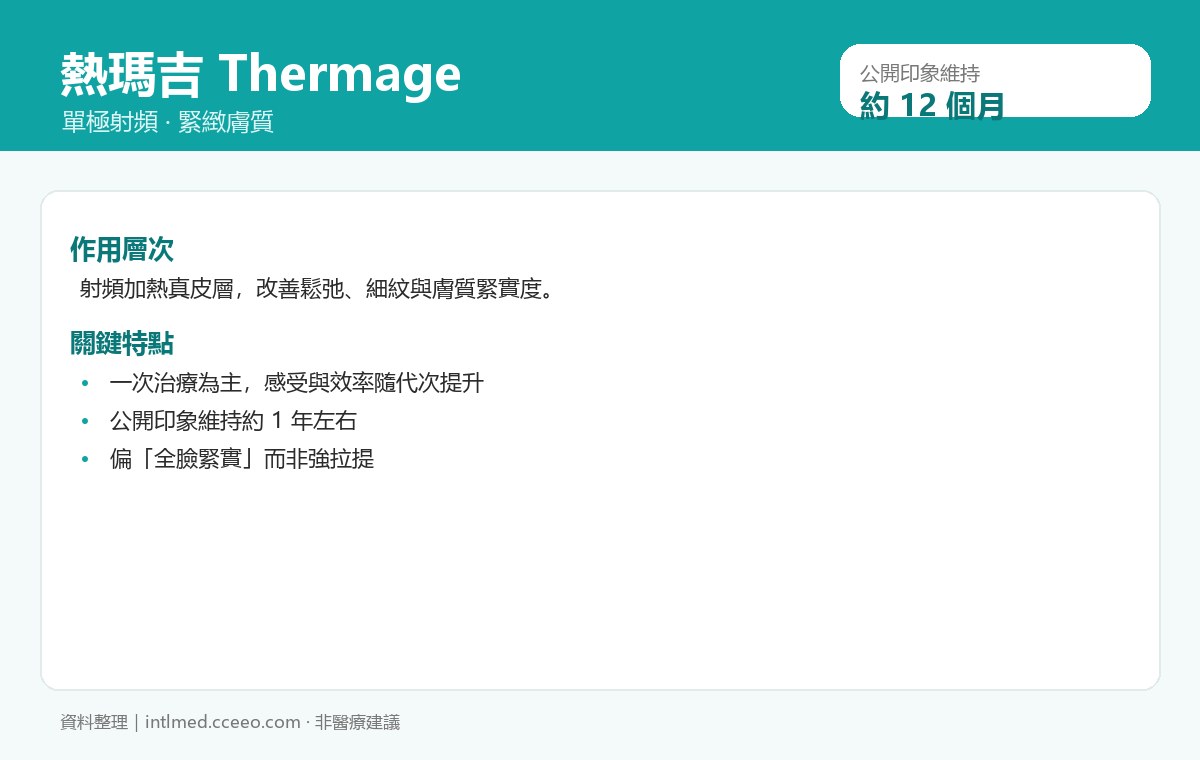
Evidence 2: Thermage’s monopolar radiofrequency targets the dermal layer, with peak effects appearing 3–6 months after treatment and sustained results lasting around 12 months. This information is derived from the device’s official specifications and publicly available medical aesthetics resources. Source: Official technical documentation of the device and compiled public medical aesthetics materials.
IV. How long does the effect of ONDA RF body shaping last per treatment?
ONDA stands out distinctly among the three options: it uses dual-frequency microwaves (2.45GHz + 5.8GHz) to tighten the superficial skin while simultaneously heating the fat layer. As a result, it’s often used on areas such as the jawline, Double Chin, arms, and abdomen—regions plagued by loose skin and excess fat. It functions more as a shaping device, complementing other treatments like the HIFU, which focuses solely on lifting, and Thermage, which is designed primarily for skin tightening.
Since ONDA’s results are closely tied to fat volume and weight fluctuations, the visible effects typically last around 6–12 months. In short: if your weight stays stable and your daily routine remains consistent after the procedure, the results will hold up better; if your weight fluctuates significantly, the contours are likely to change as well. It’s ideal for those who want to address lower jaw lines and localized sagging, rather than for those seeking deep fascial lifting.
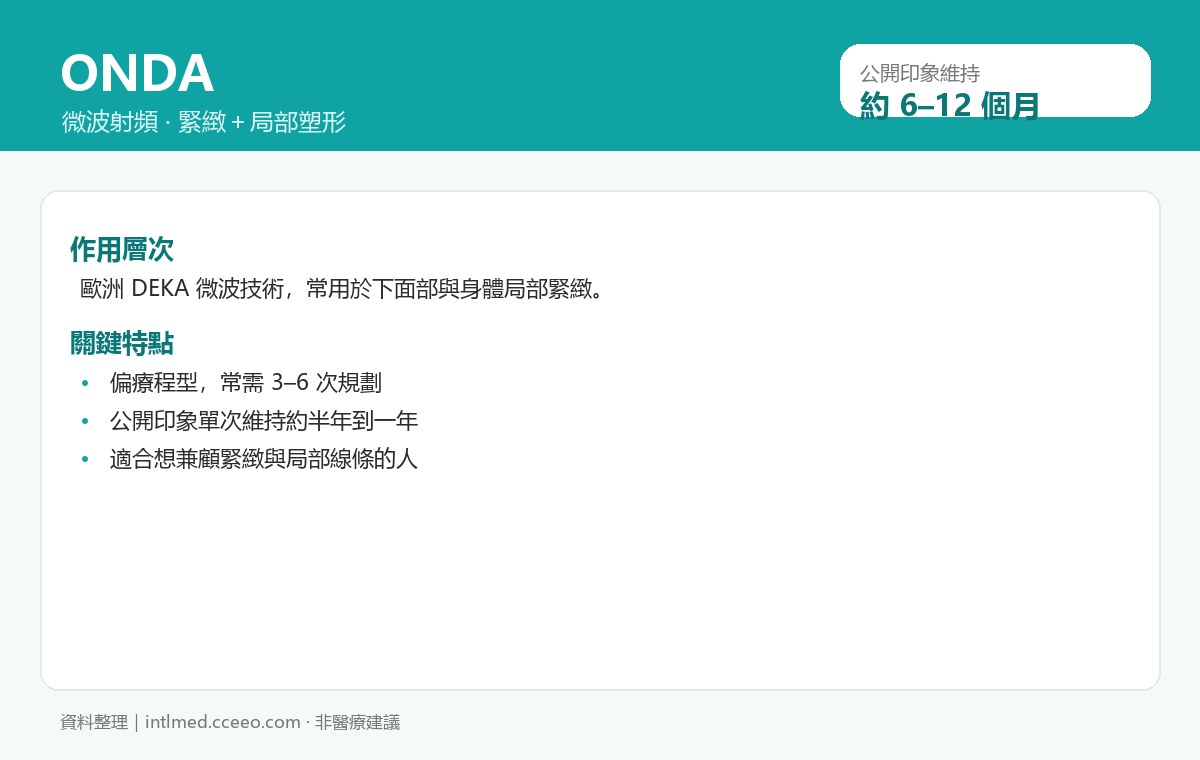
Data Point 3: ONDA’s dual-frequency microwave technology (2.45GHz + 5.8GHz), common treatment areas (jawline/Double Chin/body), and the typical duration of results (around 6–12 months), all based on the device’s official specifications and publicly available medical aesthetics information. Source: Official technical documents of the device and compiled public medical aesthetics resources.
V. Side-by-side comparison of the duration of effects from three anti-aging devices per treatment
When you lay out the three treatments side by side for comparison, their differences become clear: HIFU excels in providing deep-level support and lasting effects of around 12–18 months; Thermage is best for tightening the skin across the entire face, with results lasting about 12 months; ONDA shines in shaping the face and defining the jawline, offering effects that last 6–12 months. These treatments don’t replace each other—they target different layers of the skin to address various concerns.
| Project | Level of Effectiveness | Maintain a public image | Common Use Cases |
|---|---|---|---|
| HIFU Ultherapy | Deep SMAS fascial layer | About 12–18 months | Loose contours? Looking for deep lifting? |
| Thermage | Dermis layer (middle) | About 12 months | Full-face tightening, reduces fine lines |
| ONDA | Fat layer + skin (superficial to moderate) | About 6–12 months | Chin line, Double Chin, body contouring |
In a nutshell: For deeper lifting effects, go with HIFU; for full-face tightening, choose Thermage; and for shaping facial contours, opt for ONDA. As for which treatment to use and how many sessions are needed, it will still depend on an assessment done on the day—this article does not make any recommendations regarding which option is better.
VI. 5 Key Factors Affecting the Duration of Use for Three Types of Anti-aging Devices
When it comes to using HIFU as well, why do some people see results that last for a year and a half while others don’t even get a year’s worth of benefits? The difference mostly lies in these 5 factors:
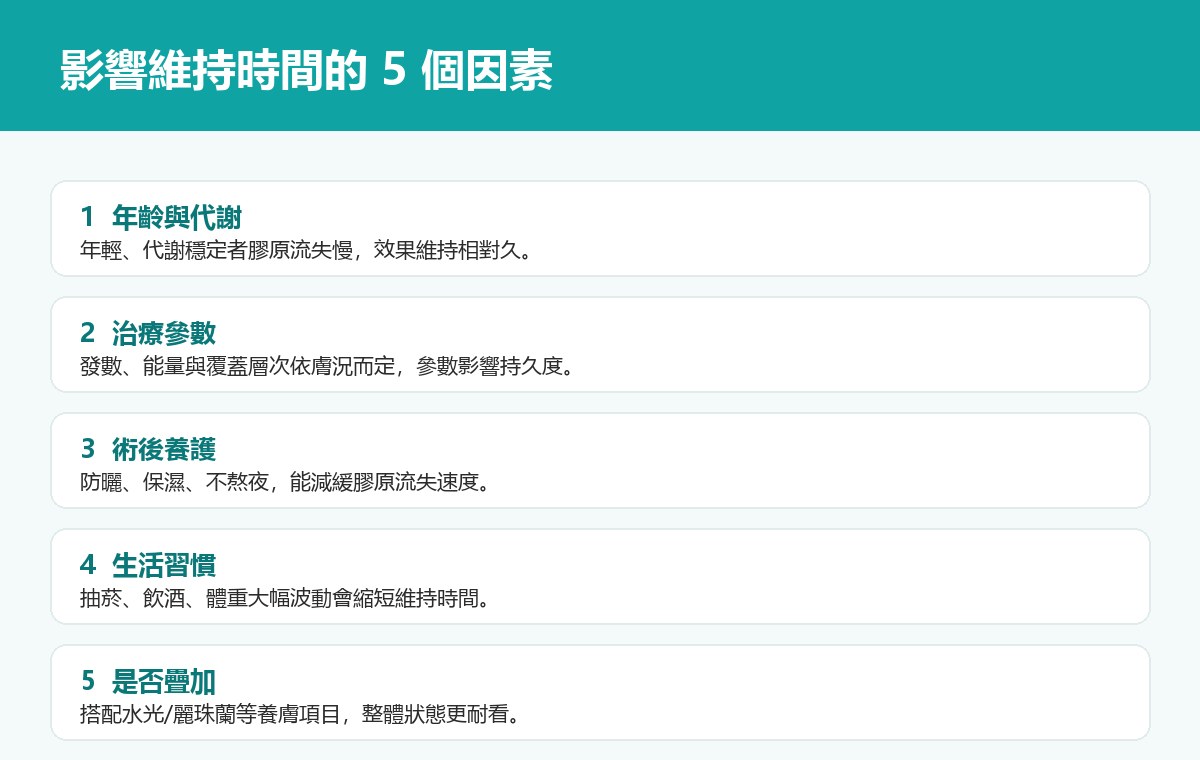
- Age and collagen loss rate: The younger one is, the better the collagen metabolism, resulting in more optimal collagen production and preservation. As people age, collagen is lost more rapidly, and the effects fade quicker as well.
- Treatment area: The blood flow and activity in the face differ from those in the rest of the body. Areas like the abdomen and arms are more affected by weight, resulting in more pronounced fluctuations.
- Pulses/Energy/Single-Session Intensity: This directly affects how deeply the treatment penetrates and how much collagen is stimulated. Lower pulse counts result in a milder sensation, but the lifting effect and longevity are usually inferior to those achieved with higher settings.
- Post-surgery care: Sun protection, hydration, as well as proper sleep patterns and diet play a key role in determining whether collagen can remain stable. Excessive sun exposure, staying up late, and overeating can all accelerate its disappearance.
- Natural aging and weight fluctuations: These are variables that no device can prevent. When weight changes significantly, sculpting effects like those provided by ONDA are most likely to be affected as well.
So rather than asking “How long will it last?” it’s better to ask “How can I make it last longer?” — the next two sections will provide specific tips.
VII. Three Anti-Aging Devices: 8 Things to Keep in Mind
HIFU targets the fascia layer, Thermage targets the dermal layer, while ONDA targets both fat and skin. Since they act on different layers, they address different issues—don’t make your choice based solely on the name.
12–18 months, 12 months, and 6–12 months are general perceptions in the market; individual results vary greatly and should not be considered as guarantees.
All three follow a “regular maintenance” approach — most people choose to evaluate whether further treatments are needed on an annual or semi-annual basis, rather than having just one session and calling it a day.
For contour lifting, opt for HIFU; for improving overall skin quality across the face, try Thermage; and for defining the jawline and shaping the body, choose ONDA. These treatments can complement each other — you don’t necessarily have to pick just one.
After HIFU and Thermage treatments, mild redness usually appears only temporarily, allowing patients to wear makeup right away. ONDA is also considered a minimally invasive procedure, though the level of discomfort and sensitivity depend on the treatment area and the specific device used.
The publicly available information usually shows an “estimated price range,” which can vary depending on the model (US version/Korean version/NEW generation), quantity, and treatment area. Be sure to confirm whether the total price includes tax and anesthesia before placing an order.
Both are referred to as HIFU/Thermage, but the generation of the device and the age of the probe can affect comfort levels and energy delivery; be sure to check which generation the clinic has before making an appointment.
Strengthening sun protection, hydration, maintaining a regular schedule, and keeping a healthy weight are key to slowing down the fading of results—these factors are entirely under your control.
VIII. How to Choose Between HIFU, Thermage, and ONDA Without Making Mistakes
The most straightforward approach is still to “work backward from your goals”:
| Your goals | Potential areas to focus on first | Maintain a positive public image |
|---|---|---|
| Loose contours? Looking for deep lifting? | HIFU (Ultherapy) | About 12–18 months |
| Full-face tightening, reduces fine lines | Thermage | About 12 months |
| Chin line, Double Chin, body contouring | ONDA | About 6–12 months |
| Want to bundle multiple levels at once | Consultation-based package (not a single device) | Varies by package |
My advice: Don’t let the phrase “longest-lasting effect” fool you. While HIFU can provide sustained results, it targets deeper layers of support; Thermage helps tighten the skin; and ONDA focuses on shaping facial contours. If you pick the wrong treatment type, no matter how long it lasts, it won’t address the real issues. Before making an appointment, be sure to check through BeautsGO to see what devices the clinic uses and what availability options are available, then schedule your treatment during the middle part of your trip to Seoul for the best results.
IX. FAQs About Three Anti-Aging Devices
X. Three Anti-Aging Devices: Related Readings and Appointment Consultations
If you already have a specific goal in mind, you can read the following articles together to help you clarify the chain from “equipment → project → clinic”:
If you’re still unsure whether HIFU, Thermage, or ONDA is right for you, or if you want to find out which generation of equipment different clinics in Seoul have and what their scheduling looks like, feel free to add me on WeChat—I’ll share with you all the publicly available information I’ve gathered.
WeChat ID: xycheng2204
Scan the code to add me and mention “anti-aging devices” in the note.

Disclaimer: This article is based on publicly available information, device technical specifications, and market trends. It is not a medical advertisement, nor is it intended for commercial promotion or medical advice. No specific medical institutions or devices are recommended. All information regarding treatment duration, price ranges, and expected results is subject to the hospital’s actual assessment and quotation at the time. Cosmetic procedures carry risks; please seek thorough consultation before undergoing any treatment and always follow the doctor’s recommendations.